What a Tattoo Has to Do With War In Ukraine

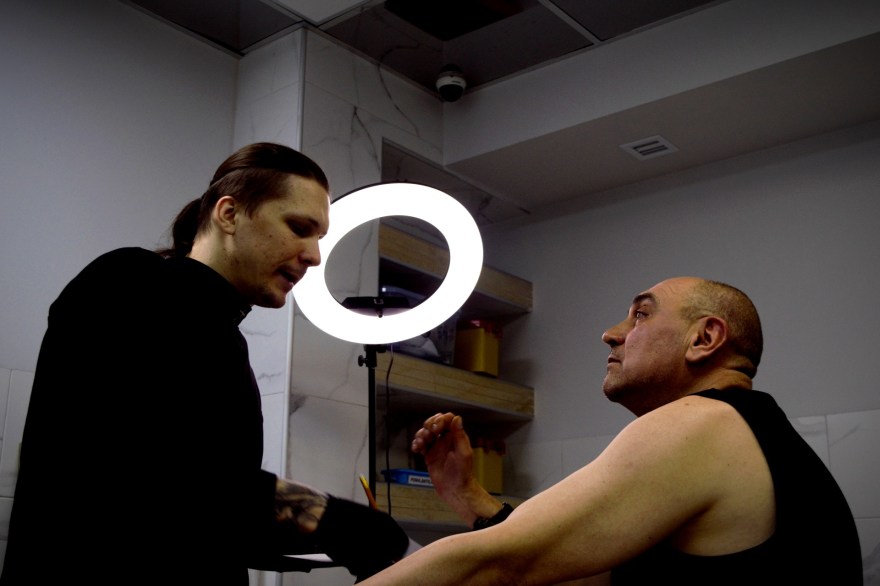
A military vet looks at a tatto artist in a studio in Kyiv.

Sergey took leave from his commander of the Territorial Defense Unit of the Ukrainian Armed Forces to get a tattoo. Joti Heir/Kyiv

The tattoo needle is buzzing, Metallica is playing softly in the background, and Sergey, a soldier with Ukraine’s Territorial Defense Forces is at the other end of that needle, taking a few hours away from the defense lines to take care of another responsibility.

“It is my duty to remember this,” he says.

The ‘this’ is Russia’s invasion of Ukraine, which began in the early hours of February 24, and has left more than 6000 people dead or injured according to the UN.

We’re in the underground of a building in central Kyiv, the cavernous white room with 5 neatly arranged tattoo beds above which hang blindingly bright ring lights is giving secret laboratory ambiance. 

Sergey’s automatic rifle rests on the floor next to the bed he is laying on. Tattoo artist Volodymyr, his hair pulled back tight in a ponytail, is huddled over Sergey’s left arm. Sergey is getting a tattoo of a yellow and blue stick man holding a bat, chasing after a swastika in the colors of the Russian flag. 

The owner of the tattoo parlour, Maria, says she’s received 7 times more requests for patriotic tattoos in the past few weeks than in the 8 years they’ve been open.

Deborah Davidson, associate professor of sociology at York University, has conducted extensive research into tattoos and meaning. She says she’s not surprised Ukrainian soldiers are turning to tattoos.

“Tattoos are a way to externalize trauma grief and thereby come to terms with it. There is element of ritual also since they invite conversation about the experiences and loss,” she explains.Volodymyr and Sergey in discussion. Joti Heir/Kyiv

Volodymyr has been a tattoo artist for 8 years, he’s heard many tattoo stories and says he’s heard one common theme behind why people choose to get a tattoo.

“It is something to provide emotional support for yourself,” he says.

“It helps you move forward and take the next step.”
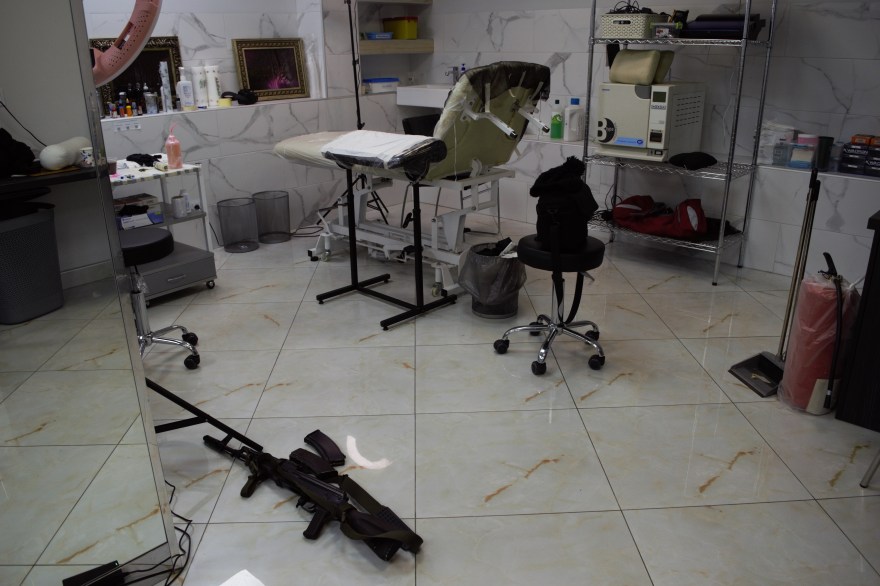
A tattoo table and a gun nearby under a building in Kyiv, Ukraine.

A 2017 paper by Everett W. Painter, Therapeutic Aspects of Tattoo Acquisition: A Phenomenological Inquiry into the Connection Between Psychological Trauma and the Writing of Stories into Flesh, echoes Volodymyr’s observations.

“Our human bodies serve to anchor us to the physical world … Disruption or threats to this system may alter self-understanding in fundamental ways. For the bearer, tattoos provide a permanent, on the body, in the flesh marker. A marker that may be used for reflection, processing, and redefinition of life experience,” Painter writes.

While headlines, videos, memes, and pictures are splashed across news sites and social media of heroic Ukrainian soldiers defending their country in a David and Goliath moment, the unromantic truth is that war is death. Ukrainian soldiers have died and will die, those that do not die will forever hold physical and psychological scars.Kyiv tattoo parlour. Joti Heir/Kyiv.

Among Ukrainian soldiers, there is word spreading that in Bucha, in what is now being called a massacre, Russian soldiers specifically targeted those sporting patriotic tattoos.

“A soldier from Volnovakha came in yesterday, his whole tank battalion was killed, only he survived. They took him as a prisoner of war,” Maria explains.

“He told us he heard the Russians say they made the people take off their shirts and if they had a Ukrainian tattoo they killed them.”

That soldier was brought to Kyiv for treatment after a POW exchange. He has healed now, Maria says. He came into the tattoo shop to get the Ukrainian trident tattooed on his neck. 

In the days leading up to the February 24 attack, Sergey says life was humming along, he works in construction and was out to nearby sites like Irpin and Gostomel.

“The night before [the invasion] I came home from work and me and my wife went to a family celebration, we came home very late,” he says.

In the morning his wife shook him awake, telling him Russia had attacked. 

“I was still tired, I didn’t believe it. It’s not a dream? It’s not a joke? I didn’t believe it was happening,” he said.

Thanks for reading Chronos! Subscribe for free to receive new posts and support my work.

When it finally sunk in, he got up, got ready, and left the house.

“I told my wife I’m going fishing, if I told her the truth, she wouldn’t let me go,” said Sergey.

The truth was he headed to military headquarters to find out what was going on and to get weapons and gear. He was already a Ukrainian Armed Forces (UAF) reservist. 

 Sergey eventually did have to tell his wife where he was of course. 

“She kept calling so I sent her a picture of myself in my uniform.”

Sergey says when they finally spoke she cried and asked him to come back alive.

“Everything changed for me in 2014, when I saw they were killing protesters,” he said referring to the Maidan Uprising that took place between 2013 and 2014 over the then government’s lean toward Russian partnership.

“I knew that when that happened, everything would be different in Ukraine,” he said. 

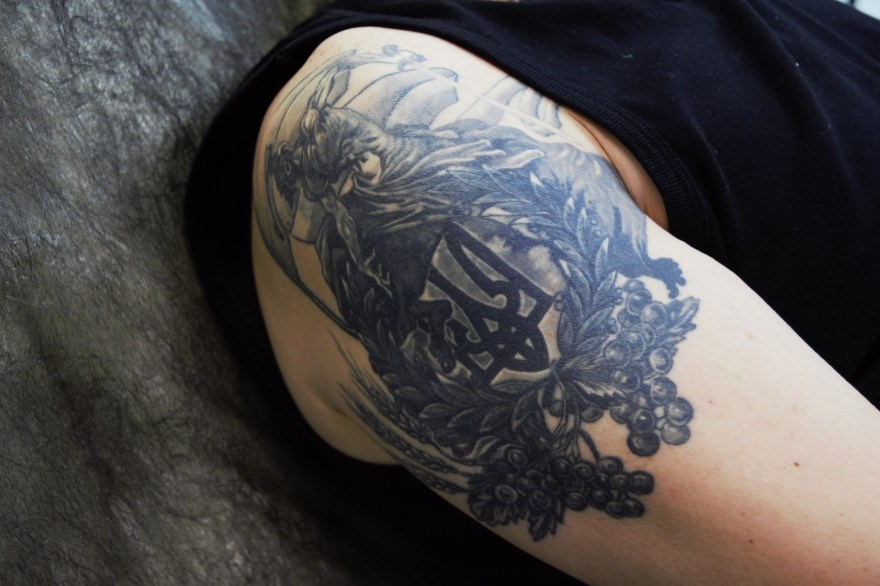
Sergey was a volunteer in Independence Square in Kyiv where Maidan protesters were camped out in 2014. Clashes between the protesters and police led to close to 100 deaths. After the pro-Russian government was ousted Sergey joined the Territorial Defense Unit, the reserves of the Ukrainian army.Sergey covered up his old Soviet tattoo with a triedent and Cossack warrior. Joti Heir/Kyiv

That’s also when he had an old Soviet navy tattoo on his right bicep covered up with the Ukrainian trident and a Cossack protector tattoo. 

On the second night of the Russian invasion, Sergey says Russians were already in Kyiv shooting from buildings.

“A saboteur group [was sent] to check the defense and to show they made it to Kyiv. They wanted to put Russian flags on buildings,” said Sergey.

“We were able to shoot them out.”
Share

A tattoo of a soldier form the war in Ukraine

Maria

On February 24, before sunrise, Maria received a call from her father.

He was in the southeast in Luhansk, near the Russian border, where the bombs fell first. He told her to get up and prepare documents for herself and her mother.

“It was early in the morning, it was dark. I went on Telegram and talked to anyone else who was awake. We tried to figure out what to do next,” she said.

Maria learned late last year from the city that her tattoo parlour sat in a designated bomb shelter. So what she had to do next was go to the tattoo parlour and prepare it to shelter civilians.

“We came here, we moved things so there could be places for people to sleep, but nobody came on the first night,” she said. 

She said they came the next night and were full every day after that. She said she would stay in the parlour with them all day and then return to her apartment in the evening to her elderly mother who refused to leave it.

About a month into the war she said she started receiving phone calls from people wanting to come in to get a patriotic tattoo. While the bomb shelter continued to run, they decided to partially open the tattoo parlour for a few hours in the day. Volodymyr is one of 3 tattoo artists Maria asked to come in a few times a week to help. 
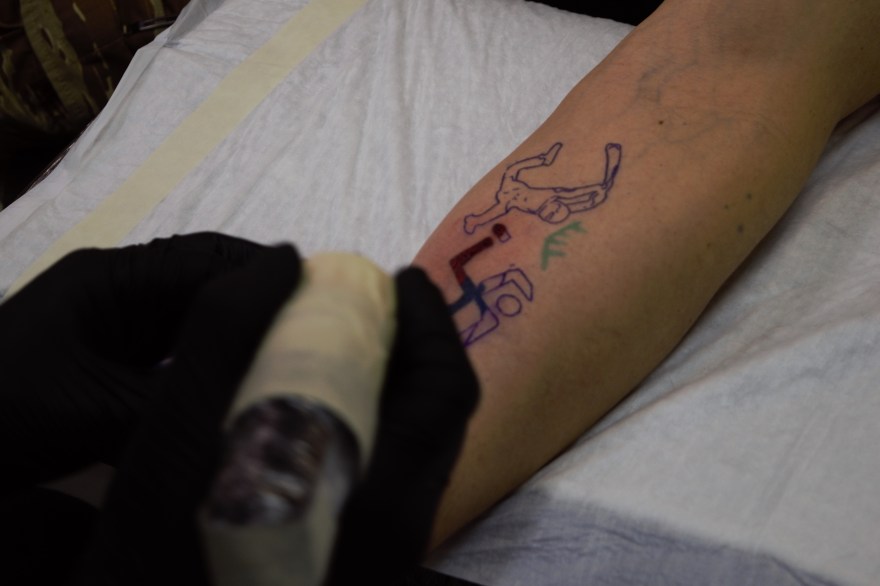
Volodymr works on a tattoo in Kyiv Ukrain

Volodymyr working on the swastika portion of the tattoo. Joti Heir/Kyiv

Volodymyr

Volodymyr has returned to work very, very angry.

“Russia hates our people, for a long time this has been going on. My grandparents lived through the famine in 1932,” he said and then apologized for getting too worked up.

He’s referring to the Holodomor famine in the 1930s that killed millions of Ukrainians, his birthplace Uman where his grandparents lived was particularly hard hit. The famine is largely believed to be man-made and has been linked to Soviet-era policies under Joseph Stalin that some say were designed to exterminate the Ukrainian people.

On the morning of February 24, he got a frantic call from his sister in Uman, telling him to get up, telling him that Russia had attacked. He said he watched the news trying to figure out what to do next. 

“I’m not sure why, but just two days before, I packed all my documents into a bag,” says Volodymyr. 

He ended up heading to the tattoo parlour and helped Maria ready it for civilian shelter. While the parlour is returning to some semblance of service it remains a bomb shelter and for that reason can’t be named.

While tattoos can provide some sort of outlet for Sergey and other soldiers, the very immediate concern is one of staying alive and uninjured. The weapons and billions of dollars being pledged to help Ukraine win the war, two months into the war, cannot delete physical and psychological trauma. War money is of little help to broken hearts and broken lives. 

Since the war began, Sergey has been living with a team of soldiers in and around Kyiv. He won’t say how many soldiers or where. All he will share is their latest spot has a lot of bats and that the food being provided is good.

Volodymyr is now wrapping Sergey’s arm up in cling film. They both look pleased with the result. Sergey says he plans to come back for another tattoo on his right forearm when he can get permission to leave from his commander.
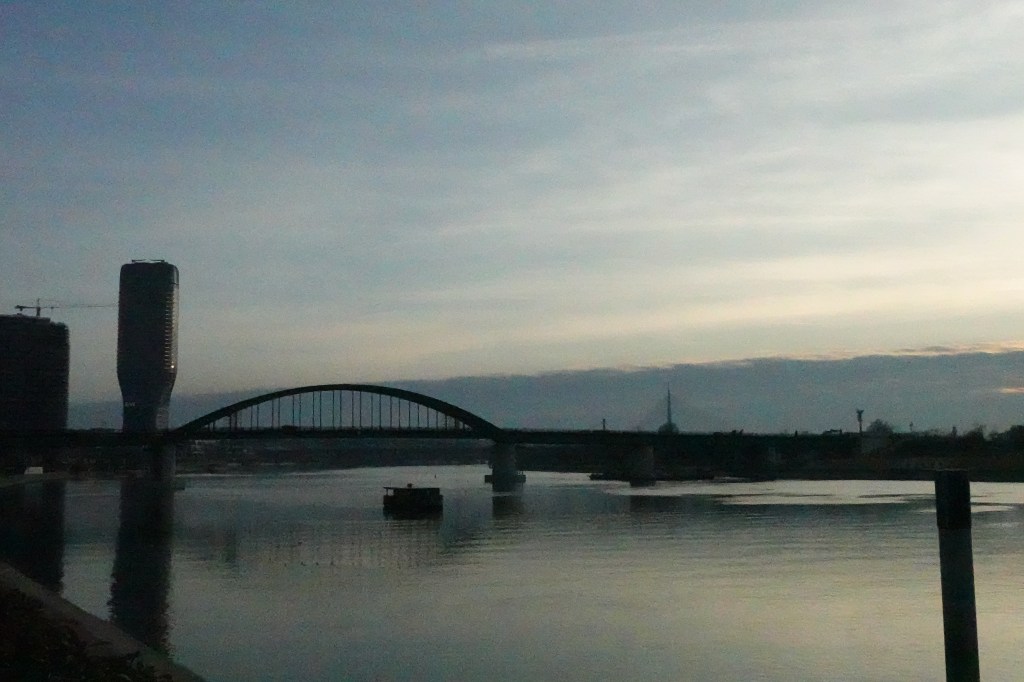
Rainy Night in Belgrade

The rain is pounding outside of my window, and I love it. Earlier today I looked at the forecast and saw there would be rain for much of the week. Since I did not want to be stuck in the apartment for want of a moving roof over my head, I walked to a local Panda store -and bought an umbrella. The rain still had not hit and so I went grocery shopping at a MAXI, they are here in Serbia, all over the place. I bought ground beef to make burgers, as well as buns, and cheddar cheese.

I also bought myself some daisies, they are very cute , but quite a lot more expensive than buying all of the things for my burger. But they are pretty and alive and I am grateful they are here 🙂

My burger is delicious! Happy I made it instead of going to McDonald’s – I really like their double cheeseburgers. But my cheeseburger was yum. Not better than theirs, maybe equally as good.

I love the sound of the rain hitting the windows, it makes me feel cozy. Had my dinner, getting ready for bed. cozy life is the best life.

The Priorities Required for Eating Shorts : A Poem

Eat shorts
Eat Shorts – Art – Joti Heir

Poem Priorities Required for Eating Shorts_

Did you eat shorts on Tuesday?

No, on Wednesday

Why wait?

I don’t know, I was busy all day

Eating shorts takes time

But the benefits are huge

You should eat a short a day

You can speed up the process

How?

Just soak them overnight

But that takes time

It takes a few minutes

The benefits are huge

Huge benefits are worth a few minutes

Well I’ll try it out

Maybe starting Monday

By then you will have lost out on four days of benefits

There is no time

I will start on Monday

But there is always time

Ok I don’t want to give it time

Ok I see.

Human Hungry

Human Hungry

if you tell me you are famished
I shall promptly gouge your eyes out
with a fork
you do not know what famished means
famished is not minutes, hours or a day
it is the days after
the pangs become soft
you try not to think about it
remove food from brain
to find place for thought
to think thought
to find food
therefore you
sit and think
driven to craziness
you know of its taste
it is everywhere
but not for you
the moments between
expectation
and
impossibility
those moments
think thought think
so you just think
than you think
you can do anything for this food
to assuage your hunger
than you realize
you will do
any
thing
it
takes
to
make the
pain of longing
for food
disappear
as you walk
past plates full
of food
that people
in blissful existence
have thrown away
they are full
too fat
too shy
don’t care about food
they have other things
to think of
food is a passing
thought
my thought
my though
my thought
as you watch
them
a bite
balanced delicately
on the tongue
it dances
oh it dances
of cabaret proportions
to the throat
slides
to waiting
stomach
you are
more hungry
think thought think
you can do
anything
for it
kill
prostitute
you watch
her push it away
it is being sent
to the dump
it is then
you realize
you cannot
you won’t
grab that
gold
off that plate
as they
look at you
with pity
at your pathetic self
shall you
climb into the dump
and pick the
food out
along
with the
disease
you realize
you cannot
then
the starvation
begins.

The Submarine and the Fishing Vessel

Who decides who gets saved and who doesn't on the open sea?
Who decides, who is going to be saved on a boat or submarine? Photo by Korhan Erdol on Pexels.com

Who Chooses Who Is Going to Get Rescued?

A billionaire and four other very wealthy people board a submarine to travel to see the Titanic wreckage in the North Atlantic – deep-sea tourism – and there is a malfunction so they are lost. Massive ships, helicopters, and expensive equipment are flown in from around the world to find them over five days. Thousands of millions of dollars in expense to the various countries like Canada, the U.S., the U.K and France as well as private participants.

A fishing vessel with a bunch of people from third-world countries trying to reach richer shores leaves Libya on the way to Italy. The vessel capsizes in EU waters near Greece. A distress call is sent to nearby vessels to help the boat. Those civilian boats save who they can. The rest are presumed dead.

Is it because one group of individuals is more valuable than the other? Is it that one group has more to offer society than the other? Is it that one group are citizens of the first world and the other group are citizens of the third world? Is it that North America can mobilize faster than the EU/? What is it?

What do you think?

The Blue Castle by L.M. Montgomery

Daily writing prompt
Do you remember your favorite book from childhood?

I’m pretty sure this book changed my life. The protaganist was a girl living amongst her clan and feeling ostrascized for being different. I don’t want to give too much away in case someone decides to read the book. But her actions and adventures once she decided to throw ‘care to the wind’ made me love her, love the book, live my best life, and it’s been in my heart ever since.

A Short Story in Progress

My right hand picked up three sugar cubes and put them to my mouth. I had no desire to ingest three sugar cubes or any sugar cubes for that matter, but I also didn’t want to get into it with my right hand. The growth year hadn’t done him or me any favors. I opened up my mouth and used my tongue to push two sugar cubes toward my left cheek and one against my right and let them melt down.

“Water please,” I said.

Air dropped down a glass of water in front of me, which I grabbed quickly with my left hand.  My right hand had lost interest in the going-ons it appeared so I swirled the water around in my mouth and spit out the sugar that remained.

It was surveillance night.  Every Tuesday dusk to Wednesday dawn for the past five years, Yeats and I have been patrolling Lambda. The Outers liked the children in this region more than others and so that was where most of the snatchings happened.

Since the establishment of intense surveillance in 3001 we had reduced the number of stolen children from an average of 43 monthly down to just five every two months. 

“I hope you’re ready,” said Yeats.

I walked over to my communicator. Yeats  regular green eyes were flashing neon on the screen.

 Be

They always flash when he has to wait for me. I wasn’t late, but I wasn’t as early as he liked. He doesn’t understand that things happen, like your clothes not appearing when you expect them to.

I hit reply.

Silko Von Cylinder and the Spring Living Room Toss

Silko is an amazing character that does his best to make good choices like how to manage his anger.The third week of March is an exciting time in Shape Town. That’s when spring begins and it’s also when the living rooms go outside.

That’s why Silko Von Cylinder was having a hard time falling asleep on the third Saturday in March. The next day was Living Room Toss Day. You can click down on the book for a free preview of what happens next.

The Case of Makhan Singh’s Smelly Lunch by Joti Heir

A children’s book about self-confidence, friendship and standing up for yourself.

Chapter 1

Nobody Likes Ugly Mouse Sweaters

Makhan Singh stuck his head out of the front door to figure out how cold it was outside. A chilly wind thwacked his face. He tried to wiggle his nose, but it felt crispy and stiff. That could only mean one thing … it was nose-hair-freezing weather.

That also meant his mom was right—he would have to wear his very warm, but very ugly mustard-coloured sweater vest to school. Makhan was already worried about making new friends on his first day at his new school and wearing an ugly sweater with a mouse on it wasn’t going to help.

“Makhan, did you put on your sweater? Are you ready? Please come and eat your breakfast, it’s almost time to catch the bus,” Makhan’s mom called from the kitchen.

“Coming,” Makhan yelled as he ran up the stairs to throw on the sweater over his shirt. The mouse looked like it was laughing at him.

“Nobody likes ugly mouse sweaters. When my other sweaters get here, I’m never wearing you again, then we’ll see who’s laughing,” Makhan said to the mouse on his sweater.

Two piping hot paranthas glistening with butter and a bowl of yogurt sat on the kitchen table

waiting for him. His 3-year-old sister Parkash tore off a piece of her parantha and offered it to Makhan.

“Thank you, Parkash, look I’ve got my own right here,” he said to her.

She put the torn-off piece into her mouth and munched on it while grinning at him. Makhan thought she was so lucky. Kids in preschool were just tall babies, and babies played with everyone. It was going to be easy for Parkash to make friends.

“Look, Parkash, your brother is going to eat all his yogurt because it’s going to make him big and strong. You’re going to eat some too, aren’t you?” his mom said.

Parkash kept on grinning and eating her parantha without touching her yogurt.

Makhan loved yogurt and buttery paranthas, but today, they made him feel sad. That’s because after he finished eating his last bite, he’d have to take a bus to a school where he had no friends.

“This is a very ugly sweater, Mom, are you sure you didn’t pack any sweaters without mice on them?” Makhan grumbled.

“Makhan, I thought you loved your mouse sweaters, that’s why I packed them in our luggage. What happened?” she asked.

“I just don’t like them anymore, that’s all,” Makhan said.

“Well, the movers are delivering the rest of our things today, so maybe we can find you a no-mouse one to wear for tomorrow. Now, eat your parantha, please. Since it’s a special occasion, I made you a sweet one,” Makhan’s mom said with a wink.

Makhan thought starting grade three at a brand-new school in the middle of November was no kind of special occasion. If anything, he’d call it a scary occasion.

“Good moooorning,” Makhan’s dad sang as he walked into the kitchen.

“Are you kids excited about meeting new friends today?” he asked.

“It feels like there’s a circus in my stomach,” said Makhan.

“Don’t you worry, everyone’s going to think you’re the nicest, smartest boy in the world,” Makhan’s mom said as she hugged him.

Makhan tried to give her a smile, but the circus in Makhan’s stomach didn’t make it easy.

“I’ll drop Parkash off at preschool on my way to work,” his dad said while blowing and slurping on a cup of hot chai.

“Thank you, that’s perfect, then Makhan and I can finish up breakfast and have a nice walk to the bus stop,” Makhan’s mom said.

He felt like a baby having his mom walk him to the bus stop, but he also felt relieved that he wouldn’t have to stand at the stop by himself. At his old school in Toronto, he had a lot of friends to stand with. He even had three best friends.

“I packed you a yummy lunch. I hope it’s ok. Ask your teacher if I should change anything,” said his mom as they put on their shoes and headed to the bus stop.

Makhan wondered if sharing his lunch might help him make friends. His mom was a really good cook and his friends at his old school always loved swapping some lunch with him.

The school bus stop was on the street next to Makhan’s street. As Makhan and his mom turned the corner to walk down bus stop street, they saw a backpack go flying into the air.

“Give me back my backpack!” yelled a girl running toward the backpack with two long pink braids flying behind her.

Just then, a yellow school bus arrived. The circus monkeys in Makhan’s stomach started doing cartwheels.

“Have a good day at school, my most beautiful boy,” his mom yelled as he lined up to get on the bus.

“Haha, beautiful boy,” someone laughed.

“Look at that mouse,” yelled someone else.

Makhan felt his face get hot as he walked up the steps of the bus.